 Add to Chrome
 Add to Firefox
 Add to Edge
Subliminal Effects in Your Data: A General Mechanism via Log-Linearity
Feb 04, 2026
Training modern large language models (LLMs) has become a veritable smorgasbord of algorithms and datasets designed to elicit particular behaviors, making it critical to develop techniques to understand the effects of datasets on the model's properties. This is exacerbated by recent experiments that show datasets can transmit signals that are not directly observable from individual datapoints, posing a conceptual challenge for dataset-centric understandings of LLM training and suggesting a missing fundamental account of such phenomena. Towards understanding such effects, inspired by recent work on the linear structure of LLMs, we uncover a general mechanism through which hidden subtexts can arise in generic datasets. We introduce Logit-Linear-Selection (LLS), a method that prescribes how to select subsets of a generic preference dataset to elicit a wide range of hidden effects. We apply LLS to discover subsets of real-world datasets so that models trained on them exhibit behaviors ranging from having specific preferences, to responding to prompts in a different language not present in the dataset, to taking on a different persona. Crucially, the effect persists for the selected subset, across models with varying architectures, supporting its generality and universality.

Diffusion Language Models are Provably Optimal Parallel Samplers
Dec 31, 2025Diffusion language models (DLMs) have emerged as a promising alternative to autoregressive models for faster inference via parallel token generation. We provide a rigorous foundation for this advantage by formalizing a model of parallel sampling and showing that DLMs augmented with polynomial-length chain-of-thought (CoT) can simulate any parallel sampling algorithm using an optimal number of sequential steps. Consequently, whenever a target distribution can be generated using a small number of sequential steps, a DLM can be used to generate the distribution using the same number of optimal sequential steps. However, without the ability to modify previously revealed tokens, DLMs with CoT can still incur large intermediate footprints. We prove that enabling remasking (converting unmasked tokens to masks) or revision (converting unmasked tokens to other unmasked tokens) together with CoT further allows DLMs to simulate any parallel sampling algorithm with optimal space complexity. We further justify the advantage of revision by establishing a strict expressivity gap: DLMs with revision or remasking are strictly more expressive than those without. Our results not only provide a theoretical justification for the promise of DLMs as the most efficient parallel sampler, but also advocate for enabling revision in DLMs.
Sample-Adaptivity Tradeoff in On-Demand Sampling
Nov 19, 2025We study the tradeoff between sample complexity and round complexity in on-demand sampling, where the learning algorithm adaptively samples from $k$ distributions over a limited number of rounds. In the realizable setting of Multi-Distribution Learning (MDL), we show that the optimal sample complexity of an $r$-round algorithm scales approximately as $dk^{Θ(1/r)} / ε$. For the general agnostic case, we present an algorithm that achieves near-optimal sample complexity of $\widetilde O((d + k) / ε^2)$ within $\widetilde O(\sqrt{k})$ rounds. Of independent interest, we introduce a new framework, Optimization via On-Demand Sampling (OODS), which abstracts the sample-adaptivity tradeoff and captures most existing MDL algorithms. We establish nearly tight bounds on the round complexity in the OODS setting. The upper bounds directly yield the $\widetilde O(\sqrt{k})$-round algorithm for agnostic MDL, while the lower bounds imply that achieving sub-polynomial round complexity would require fundamentally new techniques that bypass the inherent hardness of OODS.
Panprediction: Optimal Predictions for Any Downstream Task and Loss
Oct 31, 2025Supervised learning is classically formulated as training a model to minimize a fixed loss function over a fixed distribution, or task. However, an emerging paradigm instead views model training as extracting enough information from data so that the model can be used to minimize many losses on many downstream tasks. We formalize a mathematical framework for this paradigm, which we call panprediction, and study its statistical complexity. Formally, panprediction generalizes omniprediction and sits upstream from multi-group learning, which respectively focus on predictions that generalize to many downstream losses or many downstream tasks, but not both. Concretely, we design algorithms that learn deterministic and randomized panpredictors with $\tilde{O}(1/\varepsilon^3)$ and $\tilde{O}(1/\varepsilon^2)$ samples, respectively. Our results demonstrate that under mild assumptions, simultaneously minimizing infinitely many losses on infinitely many tasks can be as statistically easy as minimizing one loss on one task. Along the way, we improve the best known sample complexity guarantee of deterministic omniprediction by a factor of $1/\varepsilon$, and match all other known sample complexity guarantees of omniprediction and multi-group learning. Our key technical ingredient is a nearly lossless reduction from panprediction to a statistically efficient notion of calibration, called step calibration.
On Surjectivity of Neural Networks: Can you elicit any behavior from your model?
Aug 26, 2025Given a trained neural network, can any specified output be generated by some input? Equivalently, does the network correspond to a function that is surjective? In generative models, surjectivity implies that any output, including harmful or undesirable content, can in principle be generated by the networks, raising concerns about model safety and jailbreak vulnerabilities. In this paper, we prove that many fundamental building blocks of modern neural architectures, such as networks with pre-layer normalization and linear-attention modules, are almost always surjective. As corollaries, widely used generative frameworks, including GPT-style transformers and diffusion models with deterministic ODE solvers, admit inverse mappings for arbitrary outputs. By studying surjectivity of these modern and commonly used neural architectures, we contribute a formalism that sheds light on their unavoidable vulnerability to a broad class of adversarial attacks.
Distortion of AI Alignment: Does Preference Optimization Optimize for Preferences?
May 29, 2025After pre-training, large language models are aligned with human preferences based on pairwise comparisons. State-of-the-art alignment methods (such as PPO-based RLHF and DPO) are built on the assumption of aligning with a single preference model, despite being deployed in settings where users have diverse preferences. As a result, it is not even clear that these alignment methods produce models that satisfy users on average -- a minimal requirement for pluralistic alignment. Drawing on social choice theory and modeling users' comparisons through individual Bradley-Terry (BT) models, we introduce an alignment method's distortion: the worst-case ratio between the optimal achievable average utility, and the average utility of the learned policy. The notion of distortion helps draw sharp distinctions between alignment methods: Nash Learning from Human Feedback achieves the minimax optimal distortion of $(\frac{1}{2} + o(1)) \cdot \beta$ (for the BT temperature $\beta$), robustly across utility distributions, distributions of comparison pairs, and permissible KL divergences from the reference policy. RLHF and DPO, by contrast, suffer $\geq (1 - o(1)) \cdot \beta$ distortion already without a KL constraint, and $e^{\Omega(\beta)}$ or even unbounded distortion in the full setting, depending on how comparison pairs are sampled.
From Style to Facts: Mapping the Boundaries of Knowledge Injection with Finetuning
Mar 07, 2025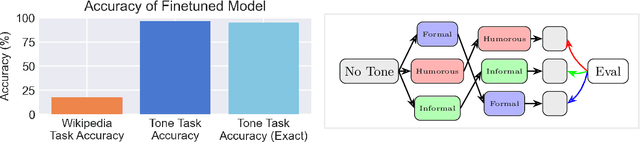
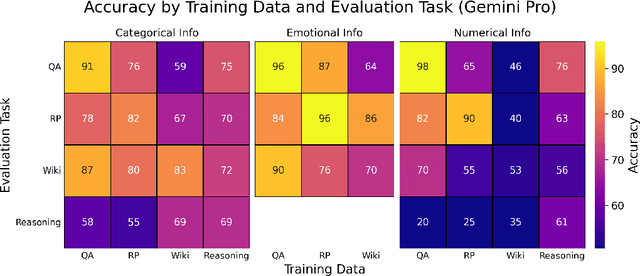
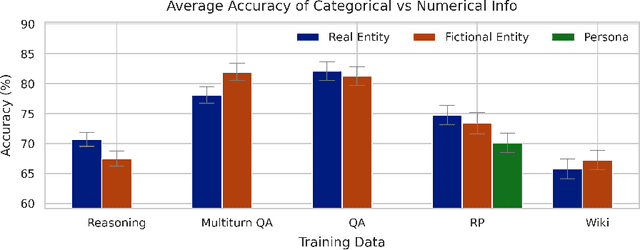
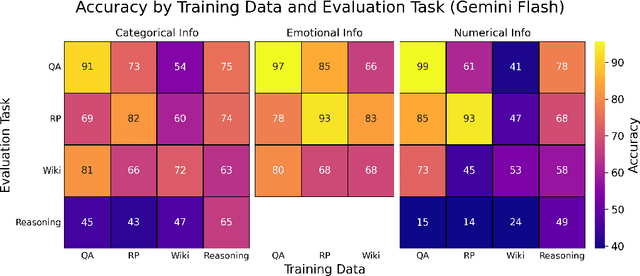
Finetuning provides a scalable and cost-effective means of customizing language models for specific tasks or response styles, with greater reliability than prompting or in-context learning. In contrast, the conventional wisdom is that injecting knowledge via finetuning results in brittle performance and poor generalization. We argue that the dichotomy of "task customization" (e.g., instruction tuning) and "knowledge injection" (e.g., teaching new facts) is a distinction without a difference. We instead identify concrete factors that explain the heterogeneous effectiveness observed with finetuning. To this end, we conduct a large-scale experimental study of finetuning the frontier Gemini v1.5 model family on a spectrum of datasets that are artificially engineered to interpolate between the strengths and failure modes of finetuning. Our findings indicate that question-answer training data formats provide much stronger knowledge generalization than document/article-style training data, numerical information can be harder for finetuning to retain than categorical information, and models struggle to apply finetuned knowledge during multi-step reasoning even when trained on similar examples -- all factors that render "knowledge injection" to be especially difficult, even after controlling for considerations like data augmentation and information volume. On the other hand, our findings also indicate that it is not fundamentally more difficult to finetune information about a real-world event than information about what a model's writing style should be.
Multi-Agent Risks from Advanced AI
Feb 19, 2025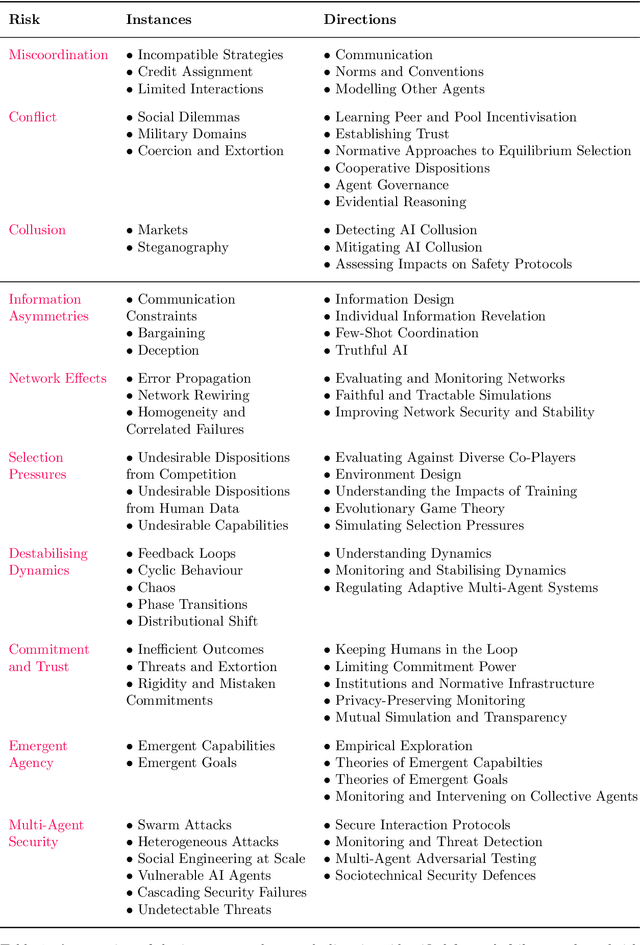
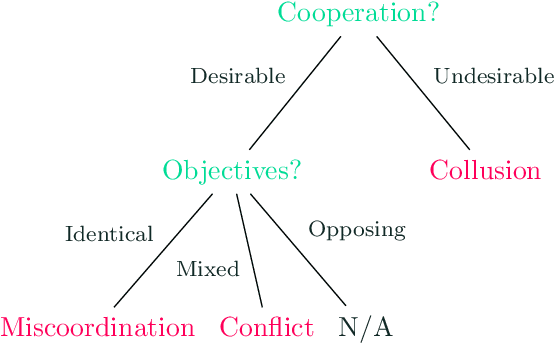
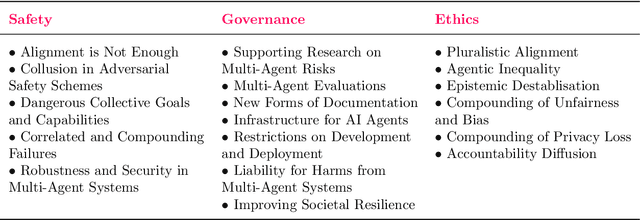

The rapid development of advanced AI agents and the imminent deployment of many instances of these agents will give rise to multi-agent systems of unprecedented complexity. These systems pose novel and under-explored risks. In this report, we provide a structured taxonomy of these risks by identifying three key failure modes (miscoordination, conflict, and collusion) based on agents' incentives, as well as seven key risk factors (information asymmetries, network effects, selection pressures, destabilising dynamics, commitment problems, emergent agency, and multi-agent security) that can underpin them. We highlight several important instances of each risk, as well as promising directions to help mitigate them. By anchoring our analysis in a range of real-world examples and experimental evidence, we illustrate the distinct challenges posed by multi-agent systems and their implications for the safety, governance, and ethics of advanced AI.
Learning With Multi-Group Guarantees For Clusterable Subpopulations
Oct 18, 2024A canonical desideratum for prediction problems is that performance guarantees should hold not just on average over the population, but also for meaningful subpopulations within the overall population. But what constitutes a meaningful subpopulation? In this work, we take the perspective that relevant subpopulations should be defined with respect to the clusters that naturally emerge from the distribution of individuals for which predictions are being made. In this view, a population refers to a mixture model whose components constitute the relevant subpopulations. We suggest two formalisms for capturing per-subgroup guarantees: first, by attributing each individual to the component from which they were most likely drawn, given their features; and second, by attributing each individual to all components in proportion to their relative likelihood of having been drawn from each component. Using online calibration as a case study, we study a \variational algorithm that provides guarantees for each of these formalisms by handling all plausible underlying subpopulation structures simultaneously, and achieve an $O(T^{1/2})$ rate even when the subpopulations are not well-separated. In comparison, the more natural cluster-then-predict approach that first recovers the structure of the subpopulations and then makes predictions suffers from a $O(T^{2/3})$ rate and requires the subpopulations to be separable. Along the way, we prove that providing per-subgroup calibration guarantees for underlying clusters can be easier than learning the clusters: separation between median subgroup features is required for the latter but not the former.
Algorithmic Content Selection and the Impact of User Disengagement
Oct 17, 2024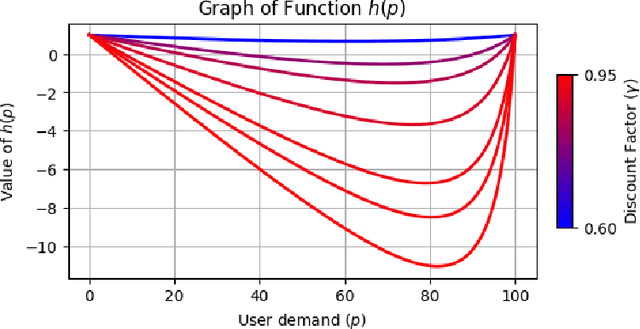
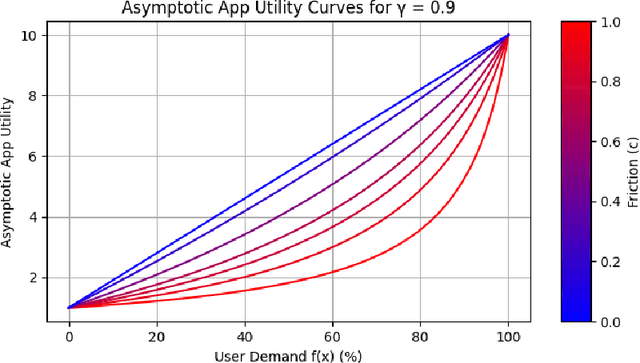
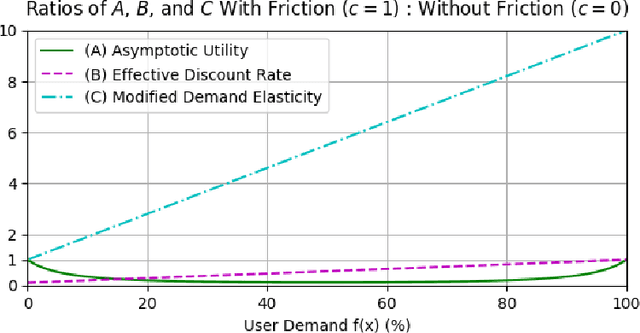
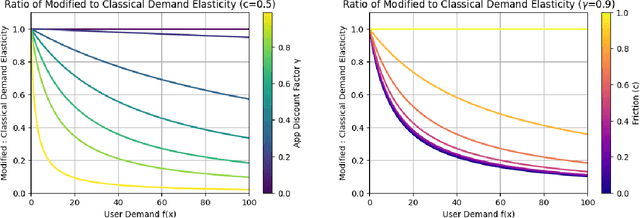
The content selection problem of digital services is often modeled as a decision-process where a service chooses, over multiple rounds, an arm to pull from a set of arms that each return a certain reward. This classical model does not account for the possibility that users disengage when dissatisfied and thus fails to capture an important trade-off between choosing content that promotes future engagement versus immediate reward. In this work, we introduce a model for the content selection problem where dissatisfied users may disengage and where the content that maximizes immediate reward does not necessarily maximize the odds of future user engagement. We show that when the relationship between each arm's expected reward and effect on user satisfaction are linearly related, an optimal content selection policy can be computed efficiently with dynamic programming under natural assumptions about the complexity of the users' engagement patterns. Moreover, we show that in an online learning setting where users with unknown engagement patterns arrive, there is a variant of Hedge that attains a $\tfrac 12$-competitive ratio regret bound. We also use our model to identify key primitives that determine how digital services should weigh engagement against revenue. For example, when it is more difficult for users to rejoin a service they are disengaged from, digital services naturally see a reduced payoff but user engagement may -- counterintuitively -- increase.